Monday, March 10, 2014

Sunday, March 2, 2014

My Power points of the "iPraise - Three i's of Praise" message:

Saturday, March 1, 2014

Following are the slides I used for my latest message on Worship - The three i's of Worship....

Monday, February 17, 2014

Raise the Praise

This month the theme of my sermons is PRAISE. My first message was on the Index, Importance and Impact of Praise, particularly looking at four P's that Praise Raises!

Below is a brief outline of the message:

Praise is a choice

“Let everything that has breath praise the Lord!” Psalm 150:6 The word "let" means to "choose to allow" - Praise is a choice and we must choose to do it no matter how we feel.

DEFINITION: “To express strong approval or admiration for someone or something, especially in public.” Macmillan Dictionary

Praising God is showering our approval and admiration on him, especially in public.

1. INDEX OF PRAISE – 7 words for PRAISE In English there's only the single word "Praise" used throughout the Bible, especially in the Psalms. However, in Hebrew (the original language of the Old Testament) there are seven words translated as "Praise".

They are:

YADAH – Hands be raised in surrender – palm outwards (Ps 63:4)

TODAH – sacrifice of praise – palm upwards (Jer 33:11)

BAROUCH – With a quiet voice – kneeling to bless God (Ps 95:6)

ZAMAR– To make music – praise on an instrument (Ps 21:13)

SHABACH – Shout for Joy/Victory (shout a name of the Lord) (Ps 145:4)

TEHILLAH – Singing praises (especially new songs)(Ps 22:3; 42:10)

HALLEL - Let your soul rejoice (clamorously foolish – eg. dance Ps 149:3)

The first thing that praise raises is our POSTURE - it gives us a POSTURE RAISE. Looking at the seven words above we see that praising God involves the whole body. Many times our spiritual posture is all hunched over in despair and defeat, but the Lord is the glory and the lifter our our heads. Let us choose to daily praise him with all our strength. As the Psalmist says:

“Seven times a day I praise (Hallel) You, because of Your righteous judgments.” Psalm 119:164 (NKJV)

2. IMPORTANCE OF PRAISE

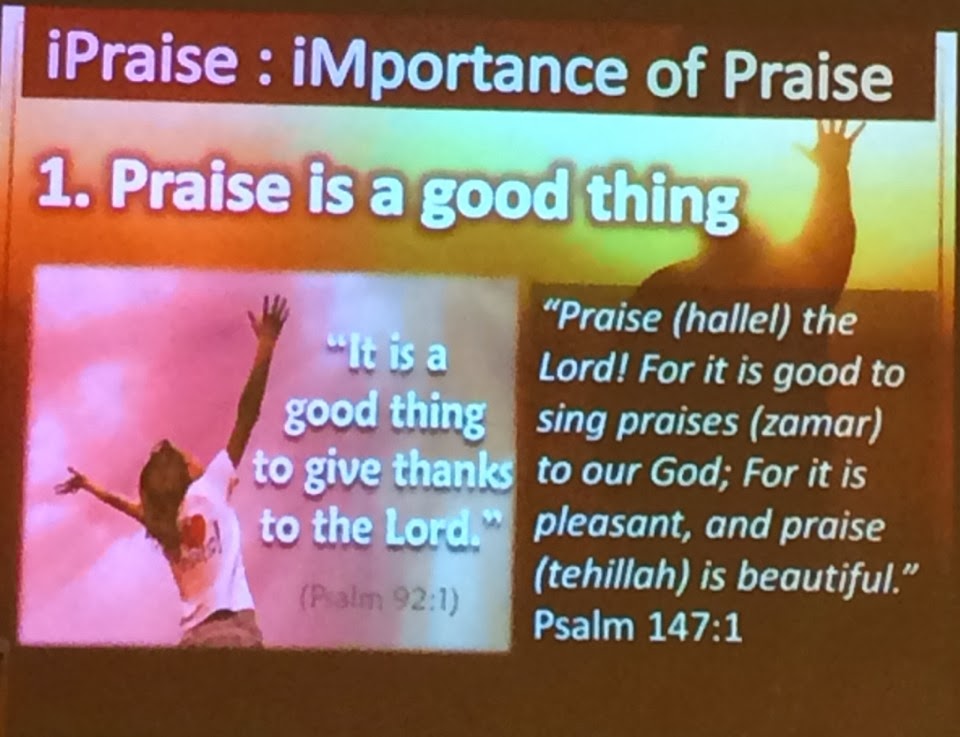
a.Praise is a good thing

“It is a good thing to give thanks to the Lord and to sing praises to your name O most high” Ps 92:1 “Praise (hallel) the Lord! For it is good to sing praises (zamar) to our God; For it is pleasant, and praise (tehillah) is beautiful.” Psalm 147:1

We are commanded to praise the Lord because He knows it is good for us. Praise is good, pleasant and beautiful. We look good in praise and it is most enjoyable.

The second thing that praise raises is our PLEASURE - it gives us a PLEASURE RAISE.

b.Praise declares who He is

We praise Him for He is… Full of glory (Psalm 138:5), Great (Psalm 145:3), Mighty (Psalm 145:4), Wise (Daniel 2:20), Good (Psalm 107:8), Merciful (Psalm 89:1), Saviour (Psalm 18:46), Faithful (1 Kings 8:56), Gracious (Psalm 103:1-3), Provider (Psalm 136:25).

The Lord inhabits the praises of His people (Ps.22:3. As we praise Him for who he is we invite His manifest presence. The atmosphere changes from mourning to dancing, from ashes to joy.

The third thing that praise raises is His PRESENCE - it gives us a PRESENCE RAISE.

c.Praise is our call and destiny

“That at the name of Jesus every knee should bow, of those in heaven, and of those on earth, and of those under the earth, 11 and that every tongue should confess that Jesus Christ is Lord, to the glory of God the Father.” Philippians 2:10-11 (NKJV)

Praise is what we are created to do and is the final destiny of all His creation. Indeed as we praise Him we are entering into His purpose and the Lord will bring greater revelation of our calling and destiny.

The fourth thing that praise raises is our PURPOSE - it gives us a PURPOSE RAISE.

3. IMPACT OF PRAISE

The fifth and last P is that praise releases POWER - it gives us a POWER RAISE.

a.Blesses God

As we praise God it impacts God Himself by ministering to Him (Acts 13:2 – they ‘ministered to God’, giving Him pleasure and blessing His heart. As it blesses Him he will in turn pour out His blessing on us.

“Thou art worthy, O Lord, to receive glory and honour and power: for thou hast created all things, and for thy pleasure they are and were created.” Rev 4:11

b.Builds us up

As we praise God it strengthens our faith (Col 2:6-7) and is good for us in so many aspects. Proverbs 17:22 tells us that a merry, praising heart is like medicine and Nehemiah 8:10 declares that the joy of the Lord is our strength. As we praise God we are strengthened, healed, filled with joy and built up!

“As you therefore have received Christ Jesus the Lord, so walk in Him, rooted and built up in Him and established in the faith, as you have been taught, abounding in it with thanksgiving.” Col 2:6-7

In Deuteronomy, God pronounced a curse on the children of Israel: “Because you did not serve the Lord your God with joy and gladness of heart, for the abundance of everything," (28:47). On the flip side, if we serve God with praise and joy then all His promised blessing are released.

c.Binds the enemy

“Out of the mouth of babes and nursing infants You have ordained strength, because of Your enemies, that You may silence the enemy and the avenger.” Ps 8:2

Why does praise defeat Satan? Satan's sin was jealousy of God. He is still driven by jealousy today (Is. 14:13-14). Even if he can't get people to worship him, his goal is to keep people from worshiping God. He seeks to draw attention away from God. When we praise God, we thwart Satan's plan, effectively silencing him and his plans against us.

Because of all this let us be like Paul and Silas. Even though they were in chains in prison they let their praises rise up to heaven. They had a POSTURE RAISE leading to a PLEASURE RAISE with a PRESENCE RAISE, PURPOSE RAISE and POWER RAISE all at once!

“But at midnight Paul and Silas were praying and singing hymns to God, and the prisoners were listening to them. Suddenly there was a great earthquake, so that the foundations of the prison were shaken; and immediately all the doors were opened and everyone’s chains were loosed.” Acts 16:25-26

Wednesday, December 26, 2012

The Gates of Jerusalem Introduction

I am just finishing a series in my Church on the Gates of Jerusalem, looking at Nehemiah 3 and seeing how Nehemiah's restoration of the walls and gates mirrors the Holy Spirit's restoration of our lives. Nehemiah's name means "The Comforter", which is a name of the Holy Spirit.

Individually and corporately we need a spiritual restoration. At the time of Nehemiah the Temple and Temple worship had been restored and Ezra had somewhat restored the reading and preaching of God's Word in the land. However, over a hundred years since returning to the land, the people were still in great distress and the walls and gates were still burnt ruins! This is often a picture of the church today - the Church buildings and worship programmes are going well, there's effective and powerful preaching of God's Word, but individaul lives are broken down and need a restoration.

As the walls and gates are restored in our lives we will rise up as mighty warriors for the Lord (see the picture - a rendering of a vision I had whilst preparing this series).

Over the next few weeks I will recap what I have preached about each Gate Nehemiah restored and how it all fits together. We need a Holy Spirit restoration so we will rise up as the army of the Lord.

Watch this space.

Wednesday, March 3, 2010

Song of Solomon - Seasons of Love


I thought I would start a new series of articles looking at the prophetic interpretation of the Biblical book Song of Solomon (also known as Song of Songs and Canticles).

Is it a Picture of Christ and the Church?

There has been a tendency to shy away from any form of allegorical interpretation of this beautiful love song due to the abuse and over imaginative manipulations of the meaning of the imagery used. However, I sincerely believe that the Church is missing out profusely on an important message if this song is seen only as a celebration of marital love (which it definately is).

The Apostle Paul saw the marriage of man and woman as a prophetic picture of Christ and the Church and indeed we see the two intertwined in his teaching in Ephesians 5, the marital union revealing the mystery of the union of Christ and His bride, the Church.

All other books in Scripture reveal God's redemptive plan and Christ can be seen typologically in every Old Testament book so why should Song of Solomon be any different? I agree that an allegorical interpretation is going too far but I do believe that we can interpret the song as an extended Type (prophetic foreshadowing) of Christ and the Church.

Solomon wrote a song that is his best out of the 1005 he wrote (1 Kings 4:32,33),for his best bride out of the 1000 he had (1 Kings 11:3-4). The Shulamite (a female version of Solomon meaning 'Princess of Peace' and showing that the woman came from a village called Shulem in Lebanon) was a poor vineyard worker in comparison to the royal origins of Solomon's other brides. In the same way Jesus wants us to hear his best prophetic song over his best (and only) bride, the Church. The Church is made up of those poor in Spirit, most not of any note in worldly eyes, but we are destined to be his royal bride.

Solomon may not seem to be a good foreshadowing of Christ or even a good example of love but neither is David a perfect Type of Christ, and yet scholars have no problem stating that David is indeed a positive Type of Christ and an example for us as a worshipper seeking the heart of God.

Interpreting the Song

Song of Songs is a JEWISH LOVE SONG. This means that in order to interpret the meaning of this book we need to understand two things...

(i) The Jewish mind.
(ii) Jewish Songs / Poetry.

(i) The Jewish Mind.

We need to look at the difference between the modern (western) mind and ancient Jewish thinking...

The Difference Between Jewish and Western Thought.

JEWISH MIND
Dynamic Understanding.
Impressions.
What something or
someone DOES (functional).

WESTERN MIND
Static Understanding.
Images.
What something or
someone IS (Descriptive)

Jewish thinking does not look at what something, someone IS (descriptive) but what something, someone DOES (functional). That is why we do not get much description of what biblical characters look like, but mostly it is about what they do (all but one (Luke) biblical writers were Jews). Therefore, in looking at the things mentioned in Song of Songs we must ask, not what they look like, but what is their function, nature, quality etc. This will give us the correct interpretation.

For example...how would you describe a pen ? How would a ancient Jew describe a pen ? Jewish thought goes, “I am not the pen...I cannot percieve what PEN is, therefore I must relate the PEN to me. How to use it ?” etc...

The Jewish mind looks at IMPRESSIONS rather than IMAGES. For example, see Song of Songs Chapters 4 & 7 . The modern mind would see an UGLY WOMAN.....

1 Behold, you are fair, my love! Behold, you are fair! You have dove's eyes behind your veil. Your hair is like a flock of goats, going down from Mount Gilead.
2 Your teeth are like a flock of shorn sheep which have come up from the washing, every one of which bears twins, and none is barren among them.
3 Your lips are like a strand of scarlet, and your mouth is lovely. Your temples behind your veil are like a piece of pomegranate.
4 Your neck is like the tower of David, built for an armory, on which hang a thousand bucklers, all shields of mighty men.
5 Your two breasts are like two fawns, twins of a gazelle, which feed among the lilies.

Song 4:1-5(NKJV)

...the biblical mind would see the beautiful personality and heart of the woman as we will see when we come to interpret these passages. Prophetically this passage is Jesus singing of the beauty of an obedient, loving Church, revealing the character of such a people.

(ii) Jewish Song /Poetry.

As this is a poetic song we must interpret the ‘heart’ of the song, not simply taking it literally. As mentioned above, we should interpret the meaning of the things mentioned (plants , animals, buildings) according to their function and biblically revealed meaning (such as the dove representing the Holy Spirit as can be seen at the baptism of Jesus with the Spirit decending as a dove).

Where there is a place or person's name it is useful to look at the original meaning (eg. Solomon = Prince of Peace).

How The Song Is Divided.

The Song is divided into stages of love by a phrase that contains “I charge You” in all cases. Mostly the phrase will be something like “I charge you, O daughters of Jerusalem, by the gazelles or the does of the field, do not stir up nor awaken love until it pleases.”( 2:7; 3:5; 5:8; 8:4 - five stages of love.)

This phrase shows us that we cannot force someone into a deeper love relationship either on a human level , or with God. Each person has to go through each season at the pace that love dictates!

The stages, or seasons of love can be given the following names.Each stage or season denotes a particular quality of the love of the woman to the man (the Church to Christ) - the higher the stage, the more mature the love.

STAGE 1: ( 1:1-2:7) : Premature Love.
STAGE 2: ( 2:8-3:5) : Possessive Love.
STAGE 3: ( 3:6-5:8) : Painful Love.
STAGE 4: ( 5:9-8:4) : Powerful Love.
STAGE 5: ( 8:5-8:14): Perfecting Love.

We see how the Beloved (Christ) constantly draws the Lover (Church) out of her comfort zone into the mountains and fields (which speaks of her calling in this world).

Many Christians have seen this book as one of the greatest missionary challenges in the Bible. Hudson Taylor wrote that Song of Songs was ‘..the strength of my life and missionary endeavour.”

In my following musings I will go through each season exploring what qualities of love should be seen in the relationship of us, the Church, with the lover of our souls, Jesus. He draws us out of our comfort zones and into His harvest purposes. The following picture describes this journey of love - You will see the terrain change as you progress through this song and it will be useful to constantly refer to this picture to plot roughly where the Bride is!


We must ask ourselves, where are we in this journey of love? The Lord is calling us more and more to a deeper level of relationship with Him. Are we responding to His love ? Are we reaching out beyond our limits into His heart, His purposes and His desires ?